

-
“A land that demands a price from everyone who calls it home.”
-
“The line between heroes and outlaws is blurred.”
-
“Redemption never comes without a fight.”
-
“Every victory carries a consequence and every buried truth is waiting to be unearthed.”
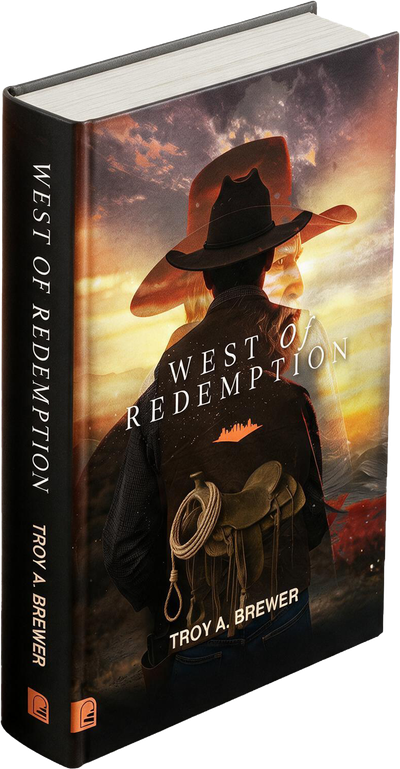
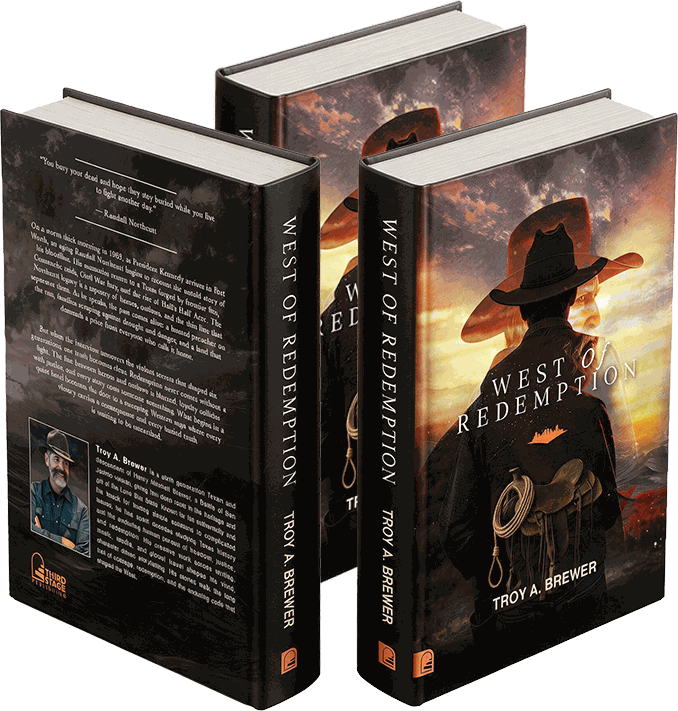
About the Book
A Texas forged
by frontier fire
On a storm-thick morning in 1963, as President Kennedy arrives in Fort Worth, an aging Randall Northcutt begins to recount the untold story of his bloodline. His memories return to a Texas forged by frontier fire, Comanche raids, Civil War loss, and the rise of Hell's Half Acre. The Northcutt legacy is a tapestry of heroes, outlaws, and the thin line that separates them. As he speaks, the past comes alive: a hunted preacher on the run, families scraping against drought and danger, and a land that demands a price from everyone who calls it home.
But when the interview uncovers the violent secrets that shaped six generations, one truth becomes clear: redemption never comes without a fight. The line between heroes and outlaws is blurred, loyalty collides with justice, and every story costs someone something. What begins in a quiet hotel becomes the door to a sweeping Western saga where every victory carries a consequence and every buried truth is waiting to be unearthed.
Read it first
Begin in Fort Worth,
1963
Six generations of Texas start on one storm-thick morning. Chapter one is free — read it, or hear Troy read it.
Chapter One

INTRODUCTION
FORT WORTH, TEXAS
TRANSCRIPT FROM RECORDED INTERVIEW
WITH RANDALL NORTHCUTT
NOVEMBER 21, 1963
RANDALL NORTHCUTT
My Grandmother Zarah used to say that God made people the way He made Texas. Extremely different and exact opposites from one part of the state to another, and from one season to another. She said people were like that.
But when it came to family, it didn’t matter if you were from the Big Thicket or West Texas sand; you still waved the same flag. God, she loved our family.
She was a wise woman. I wish we’d all been like her.
[Chair scrapes against the floor. Footsteps toward the window.]
Have you heard about my grandmother, Zarah?
BILL JENKINS, Reporter
Um, yes sir. I’ve read about her and her big Comanche Indian battle. The rattlesnake buttons and all, but I hear she was some kind of faith healer.
RANDALL NORTHCUTT
Oh, she was a healer. Really, an oracle of sorts. She was a-preaching a long time before women were allowed the privilege. She just wasn’t one to ask permission, you see.
For six generations, the Northcutt family has seen its share of good and bad. From season to season and from cousin to cousin.
Through it all, we fought for Texas, the ranch, our family, our country, our people.
You bury your dead and hope they stay buried while you live to fight another day. That’s something my daddy taught me.
[Sound of something dropping on the floor.]
BILL JENKINS, Reporter
Um... Can you talk more about that? Sorry, I knocked over the...
RANDALL NORTHCUTT
As a great-grandfather now, I know that within every new generation comes the potential for good ones and bad ones. There’s a few weeds in the field, but I’ve got a crop of good ones. Sure do.
So, what can I tell you, Mr. Jenkins?
BILL JENKINS, Reporter
I’d like to hear the whole story from you, the whole Northcutt family saga. I’d like to know if there’s any truth to what people say. I’d like to hear it straight from the truest source.
RANDALL NORTHCUTT
Oh, I’m not the truest source. I’m just the truest one living. The truest has been gone for a long time now. Feels like a million years…and yesterday, all at the same time.
[Footsteps. A chair dragged across a wooden floor.]
Back in the season when I went through my darkest trial, I didn’t know if there would ever be a good story to tell.
We were right for a while, but by the end, everybody was wrong. I saw a chance, just a little chance for things to be right again, and somehow some of us got through it.
So much pain. So much loss. Sure was.
But it turns out the good Lord has a way of bringing redemption out of the mess. Good Lord, what a mess.
[Laughter. A pause.]
I can tell you a yarn or two. I won’t tell you what I can’t tell you. But I can tell you God favors the people mean enough to refuse to leave the fight and selfless enough to hope for something better for somebody else.
BILL JENKINS, Reporter
That’s a great quote, Mr. Northcutt. I’ve been looking forward to this for a very long time. Of course, this will have to be printed and told in later publications. The big news for a while is going to be the President’s visit today.
RANDALL NORTHCUTT
John F. Kennedy himself with that Jackie standing next to him on what used to be Hell’s Half Acre! I never imagined it.
[Chair moves. A match is struck. Footsteps back toward the window.]
It might rain a bit in the morning. I hope he gives a better speech in Fort Worth than he does over there in Dallas. “The soil of no state in the union has been crimsoned with the blood of so many brave defenders as that of Texas.”
J.W. Wilbarger, Indian Depredations in Texas (1889)
CHAPTER ONEBrood of Vipers
HOTEL TEXAS
FT WORTH, TEXAS
NOVEMBER 21, 1963
Randall Northcutt was seventy-seven years old when he gave his famous talk to Bill Jenkins. Jenkins, a writer for both the Star-Telegram and the Fort Worth Press, was a mature and rather healthy forty-five.
Usually confident and on point, he found himself a bit nervous with the likes of Randall Northcutt. He was a legend, and giving Bill the time of day made him feel like he was back in Iwo Jima.
He took notes with his pencil on a yellow, faded pad. Sometimes there were names. Sometimes there were questions. Most of the time, there was a whole lot of scribbling that only made sense to Bill.
Centered on the table was a Philips’ brand reel-to-reel tape recorder. He had heard the chatter that the same company, earlier in the year, had released something called a compact cassette that could basically miniaturize the whole recording process. He had never seen one, though.
Though Randall was approaching eighty, he didn’t like to sit down for very long. He continued to get up from time to time to light his pipe and stare out the window towards the corner of Main and 8th. Thick grey clouds of “Irish puff” would swirl through the drapes and escape through the open window.
It was 8:08 a.m.
Breaking the silence, Bill said, “You are a registered member of the Sons of the Republic of Texas, so your family goes all the way back to the beginning.”
“That’s right, sir,” Randall nodded. “My great-grandfather, Henry Northcutt, came to Texas in 1834. By the grace of God, he missed the Alamo in ’36 but fought with Houston at the Battle of San Jacinto later that same year. He was with Gillaspie and the Sixth Company.
There’s been much written about those eighteen minutes, but it wasn’t just the war that was revolutionary. It was the land that was granted. Up to thousands of acres was yours for the taking and for the managing. True freedom and a place to live and die for that was all your own.
All you had to do to keep it was to battle smallpox, starvation, bandits, winters, droughts, and the entire Comanche Nation. You fought like the devil, went to church every Sunday, and birthed your children along the way.
By the time my grandfather was born, Texas was about to become the twenty-eighth state in the Union. Henry and Della had twins. Randall, my namesake, of course, but they called him Rand, and his twin brother, Robert. Robert would be my grandfather. You will remember him as Big Bob, I bet.
A few years later, they had a girl named Jayne and yet another boy, Raymond.”
Jenkins held his pencil in the air. “The same Ray, ‘Smiling Ray,’ the gunfighter?”
“He fought with guns a time or two, yes,” Randall answered. “You did your homework, Mr. Jenkins.
Great-Grandfather Henry went off to the Mexican War in ’48 and came back to another new addition to his growing family, a baby girl named Loraine.
Now, Rand and Granddaddy Robert were inseparable. They were twins of the highest caliber, and like my own twins, Jefferson and Jackson, they were fraternal twins.
My Papa told me they called them ‘feast and famine’ because Randall was unusually tall and thin. Papa was a good three inches shorter and beefy. Though he wasn’t nearly as tall as his brother, folks went to calling him ‘Big Bob,’ especially after the Civil War.
Frontier life must’ve been full of wonder and fear for them as boys, no doubt hardship. Granny Zarah grew up during the same era. She had some stories!
So, you know your history, Mr. Jenkins.
Texas was doing fine as a nation and the promised best state in the Union, that is, until the great Civil War took place.”
BLANCO COUNTY, TEXAS
(near the future site of Johnson City)
JULY 15, 1860
Anthony Bewley had been a Methodist circuit rider out of Tennessee. It had been more than twenty years since he rode through the Smoky Mountains, but now, approaching sixty, he was riding harder than ever. This time for his life.
The sound of spurs outside the door meant there would be a knock or even gunfire. Expecting hostility, he was relieved to hear the voice of an old familiar friend. It was Henry Northcutt.
“Reverend, it’s me, Henry.”
“Thank God it’s you, Henry,” as he opened the door. “My trusted friend, what news have you?”
“It ain’t good,” Henry lamented. “The letter keeps getting printed in newspapers across the state. All of ’em saying you’re going to rally up the people in herds, free the slaves, and join Houston in leaving the Confederacy.”
Anthony shook his head. “If only I wielded the power they accuse me of.”
“They’ll kill you, Anthony, if they catch you. We can’t wait this out, and it won’t simmer down. We’ve got to get you across the Red River to your people where you’re safe.”
The letter Henry was referring to had been addressed to Bewley and supposedly was written by a fellow abolitionist, William H. Bailey. Most likely a forgery, it had urged Bewley to continue with his work in helping to free Texas from slavery and was “found” by a newspaperman.
“There’s no way to untie this knot. They are calling you a John Brownite,” said Henry.
Reverend Bewley took a step back and lowered his voice. “I’ve been called worse.”
Henry cut in, voice tight. “Yes, sir, but not with this considerable threat. There’s a bunch of snakes riding hard to find you, and they’re dangling a noose off one of their saddles.”
“Brood of vipers, Henry. Where are they now?”
“They’ve gone further west, reckoning you for the falls on the Colorado River. I can get you as far as Fort Worth with my friend Jonah Dewalt, and from there, my partner, Paint Caldwell, is going to get you across the river.”
“Can he be trusted with my family, Henry?”
“Reliable to the hilt,” assured Henry. “He’s what I would call a real wheelhorse.”
Bewley put his hand on the leather-clad shoulder of Henry Northcutt. “And you are my trusted friend, Henry. Let us make haste without stopping for nothing except my bride and children.”
“We’ll get your rib, preacher.” Henry groaned and, turning for the door, his hat was back on his head before he was through the threshold.
HOTEL TEXAS
FT. WORTH, TEXAS
NOVEMBER 21, 1963
8:26 AM
Randall continued, “Bewley and Great-Granddaddy didn’t know it, but that mob had arrested a ‘blue belly’ unionist by the name of Crawford. They beat the hell out of him right here on what would later be known as Hell’s Half Acre. Even in its infancy, the acre was used for such spectacles, and nobody tried to stop it. It wasn’t good.
They drug him kicking and pleading to that big old pecan tree you see off White Settlement Road and Jacksboro Highway.”
Turning to Jenkins and, looking genuinely concerned, they understood each other. He peered back at Bill and said, “Do you know which tree I’m talking about?”
“I believe I do, sir,” he said, looking up from his pad and deciding to visit the tree very soon, maybe with a metal detector. “Just across the Trinity.”
Once confirmed, Randall was fully engaged in the conversation. He turned to look back out the window. Jenkins observed the back of his head as a small cloud rose from in front of his hat. “Great-Granddaddy Henry handed the preacher off to Paint Caldwell, and he got across the Red River and all the way to Fort Smith.”
For the first time, Jenkins interrupted. “Is that Paint Caldwell, the so-called ‘Paul Revere of the Texas Revolution’ - that very same man?”
“No, sir,” Randall answered. “He died a decade or two before, but because he was so famous, I think any boy growing up at that time named Caldwell might’ve picked up the nickname ‘Paint’.”
“Right,” Jenkins said as he scribbled, No Relation beside the name Paint.
“Anyway, it didn’t do any good.” The color changed in Randall’s voice.
“Once Preacher Bewley made it up into Missouri, he for sure thought he was safe. A posse chased him all the way up there and came thundering upon him. They took him back to Fort Worth under the point of a gun and an escort on the stage.
On the night he got here, they hung him on that very same tree you said you recognized.”
“Oh, that’s awful,” Jenkins said.
“It was only the beginnings of awful,” muttered Randall.
FORT WORTH, TEXAS
SEPTEMBER 13, 1860
After a ten-day ride back to Fort Worth from Missouri, Reverend Bewley sat in the Fort Worth Jail. He was tired and exhausted after being kidnapped by a small posse and forced to come with them to Texas. They abused him with taunts and threats, but no physical harm had come to him yet.
Instead of handing him over to the law, Bewley was to discover that one of the vigilantes had keys to the jail himself, a curious finding that loomed with certain dread.
Nighttime had come, and just outside, he could hear the sounds of music, laughing, and an occasional gunshot from the area that would come to be known as the notorious Hell’s Half Acre.
Referring to the comparable circus noises outside, Bewley quoted the Bible in a solemn tone.
“And when Joshua heard the noise of the people, he said unto Moses, ‘There is a noise of war in the camp.’ And Moses said, ‘It is not the voice of them at war, but the noise of them that sing do I hear’.”
He paused.
“Exodus 32, that is. In case you’re wondering…” No response from the only other man in the room. “When they worshipped the golden calf.”
The jailer seemed uninterested and was busy writing a letter to a woman he knew in Waco. He was obviously struggling with words and penmanship.
“Will you not at least bring me a Bible, Mr. Benton?”
His concentration broke. Benton stopped writing and looked into the dark cell from his lamp and candle.
“You don’t need one, Bewley. You spit out more scripture than the Baptist encampment. Just shut up and go to sleep.”
“We all need a Bible, Benton. You should get one.”
Benton gave a threatening look towards his captive. “Save it!” “I’ll save my sermon for the jury and for he that hath an ear,” he said, turning for the cot and the blanket.
“There ain’t gonna be no jury, Bewley. We’re going to hang you from the same tree we hang all Blue Bellies and John Brownites.”
“There it is,” Bewley said. “A fleeting glimpse of truth.” Bewley put his face between the bars and began to speak as if he were behind a pulpit or even in a courtroom.
“I am neither, Benton. I am born of the South, from Tennessee. I have never met John Brown and was considered too liberal for the Missouri Convention. They sent me southward. Yes, it’s true I have a holy hatred for slavery and chains on men, but I have never been a part of an insurrection against Texas.”
Before Benton could answer, he was alerted outside. A crowd of men had gathered, and they were no doubt there to lynch him.
Benton got up and unlocked the iron bar door on Bewley’s cell. He put on his hat and went to unlock the front door of the jail.
“Preacher or not, you run your mouth, you pay the price.”
With that, he turned the key and the door opened to a mob of more than thirty men. Two men entered the building.
“Hello, boys,” Benton said. “Your appearance is well-timed. This dandy is preaching my ear off.”
A young and determined Douglas Beller and a local merchant, E.M. Daggett, stepped into the jail and saw Bewley standing near the open door of his cell.
“Yeah, that’s him,” said Daggett. “We’ve got our man. Reverend Bewley, you have preached your last, and a lot of good it did for you.”
“I wasn’t preaching for my good, Mr. Daggett. You are set to kill me no matter what I say.”
“You’ve said plenty,” fired Daggett. “We’re fix’n to hang you now.”
“Then let me preach this, ‘Blessed are ye, when men shall revile you, and persecute you...” The Reverend was excited, with a mix of confidence in his words and fear for his life. “Shut your trap,” snapped Benton, moving inches away trom Bewley’s face.
“... and shall say all manner of evil against you falsely,” Bewley nearly shouted the last word and continued. “For My sake. Rejoice, and be exceeding glad: for great is your reward in heaven.”
Beller snarled through the bars, and Bewley could smell the stench of his breath. “Well, if your reward is in heaven, tonight you will be collecting your earnings. We’ve collected ours, haven’t we, boys?”
Several agreed in laughter. “Sure have.”
E.M. Daggett took several steps towards the open cell. “Five hundred dollars paid for by the Knights of the Golden Circle. All that money to track you down and hang you high.”
Daggett held up a piece of wrinkled paper, and Bewley struggled to read it in the flickering candlelight.
“Let’s go get your reward, preacher.”
In less than one minute, they had him on a horse, his hands tied, and a bag over his head. Five minutes later, the thirty men took him across the Trinity River in a gallop of splashing hooves with yells and whistles. Bewley, having his hands tied behind his back and unable to hang on to the saddle horn, fell off into the shallow water, busting his head considerably. Stepped on by nearby horses, his injuries were substantial.
The mob began cursing, and several men dismounted to pull him out of the dark water. His cloth bag over his head was now a bloody, wet mess. Since he was unable to stay in the saddle, Daggett rode next to him and held on to his shoulder, keeping him upright. Beller, riding hard from the other side, reached out to support the sleeve of Bewley’s left arm.
A few times from under the bloody bag, Daggett could hear the muddled prayers of a frightened and half-conscious man. His groans and pleadings were a mixture of scriptures and familiar phrases of hymns that even Beller recognized.
Once the noose was around his neck, without pause or ceremony, they slapped the horse out from under him. Because of his slower exit off the horse, Bewley’s neck did not break. He kicked and strained in agonizing strangulation as he swung from south to north and back again. He hung there, dangling and strangling for what couldn’t have been more than a minute. It felt like the long, mean stretch of forever, where time could never be told for the suffering.
The fierce pressure behind his eyes was so great he feared his head would explode, or his eyes might pop from their sockets.
In the midst of sickening pain and horror, Bewley was aware that the only sound he could actually hear was his boot heels as he kicked for relief. He never heard the crowd of men or their laughter. Just his brand-new heels that he had picked up the day before his arrest. Losing all strength, he heard his heels click and clash one last time.
His life began to quickly dim. Then he heard something else. He knew what it was immediately. It was singing, the sound of beautiful singing.
Bewley’s body went limp, and the riders rode away from the Trinity.
HOTEL TEXAS
FORT WORTH, TEXAS
NOVEMBER 21, 1963
8:52 AM
Randall Northcutt looked back across the table and then down into his pipe. He knew it needed cleaning.
“That was Henry’s friend they did that to.
Do you know they let his body rot and later threw his bones on the roof of E.M. Daggett’s trading post for all to behold and for children to play with?”
Randall, coming back to his chair, repeated and shook his head, “That was Henry’s friend they did that to.”
He settled in and leaned back. “I never met Henry, but Big Bob Northcutt said that between the death of his friend and the Civil War, Henry proved he had the ‘hair of the bear’ in him.
Henry wasn’t as religious as Bewley, and when he heard what happened, well, that’s what kicked up the killings and started the blood flowing. Even from one generation to the next.
The Civil War was about to occupy everything, and with all that chaos came the fury of Henry Northcutt.”
JOHNSON COUNTY, TEXAS
OCTOBER 1, 1860
Henry stopped to water his horse and get cleaned up near Buffalo Creek. He didn’t see anybody he recognized at the trading post except for a couple of people he didn’t want to talk to.
An eight-mile ride north would put him at his cabin and into the arms of his wife, who he knew had been expecting him home at least four days earlier. He hated to make her worry, but there had been no way to communicate with anyone in Erath or Somervell County.
The fall rains had caused the river to rise high, and he couldn’t get past it at the usual ford. He had tried Brewer’s Crossing near Goat Neck, but they were out after the Indians who had stolen their horses and burned their corn crib to the ground.
He had taken a recent harvest of squash, okra, and a wagon full of corn to Barnard’s new grist mill on the Paluxy River. From there, he went on to Chalk Mountain to work with the trading post and do as much business and honest work as time would allow.
A band of Comanche was said to be on a warpath, so he had to lay lower than what he liked. He had planned to bring back an additional fourteen beeves and somewhere around thirty goats, but the men who were with him had to ride off to their homesteads and defend their families.
Henry’s place was thirty miles east of the warfare, so he wasn’t as worried about his own possessions and family. That’s when the heaviest of the rains came. He stayed near the mill for nearly a week in hopes of collecting people he trusted to drive the cattle and herd the goats with him back to the grove.
It turned out to be fruitless as he waited out the storms. So, he left his herd grazing with Barnard near his mill. He would have to come back in a few weeks and gather them all again.
In any case, he was almost home now. Just south of Caddo Grove, he would immediately see his boys, Rand and Bob. Maybe one of his girls, or even Ray, might see him first. He knew he would have some explaining to do and a story to tell.
Several miles away, he could see Caddo Peak, and that meant he was on his property, though there was no fence to indicate it, yet.
Once through the trees, he saw his home of a cabin, and his wife and littles on the dog run porch. He felt relief, and even his horse, Hay, blew a snort through his enormous nostrils.
“We’re home, old Hay,” he said, patting his neck beneath his brown mane.
The kids got excited about seeing their daddy riding towards the cabin. Della, whom he called Dish, came running to meet him. She was saying something he couldn’t make out, and the closer he got, the more he realized she was in great distress.
Henry gave his horse a good kick and, in half a minute, was to his wife and off his saddle.
“Henry,” she said with tears streaking down her frontierweathered, but still beautiful, face.
“What is it, Dish? What happened?”
“It’s the boys, Henry,” gasped, Dish, now unable to speak for sobbing.
“Rand and Bob?” looking over her shoulder to count his children. “Dish, where are the twins?”
“They’re gone to join the war, Henry,” she said desperately. “They left for Fort Worth with several other boys from Pony Creek, and a handful of men who came to get them. There was no stopping them, and now they are gone to the war.”
Henry thundered. “My God, a considerable contribution. They are only sixteen! What good could they do for that damned war?!”
Dish continued, “Rand said they’d been thinking about it for some time, and something about duty and such. It just can’t be, Henry, but you were nowhere to be found.”
“My God in Heaven,” Henry exclaimed.
“I sent Jonah Dewalt the next day to fetch you. He said he would find you, Henry.”
Moving his hat back to palm his hair, he said, “Well, he never made it to me. The river was high, Dish.”
Henry was desperate for information and the ability to process. He began to wonder and feel dread about Jonah Dewalt. A sting of guiltiness on the boys being gone, the anguish of his wife…
“Wait, what…,” Henry fought to ask the right question as his historically clear mind exploded. “I mean, how long they been gone?”
“Nine days,” she said, wiping her nose. “They are long, long gone. Who knows where they sent ’em?”
“I’m gonna find out,” he said, putting his foot in the stirrup.
“Where are you going? Henry, don’t leave!” pleaded Dish.
Henry tightened the reins and exhaled, “Fort Worth.” And now he was fully mounted.
With her left hand on the bridle and hanging onto his leg, she desperately pleaded, “They are not going to let you have them back. They are more than halfway to Tennessee by now.”
“I’ll see about that,” snarled Henry. And snapping the reins from her grasp, he kicked hard.
“Be well and hold the house, Dish.”
As Dish watched her husband ride hard to the north, she fell on her knees surrounded by her remaining children. They had seen their mama cry before, but never like this.
Years later, Ray would recall seeing tears on his father’s face as he turned his horse towards Tarrant County. That was the first and last time he saw Henry Northcutt cry. One of many family secrets he would take to his grave.
HOTEL TEXAS
FORT WORTH, TEXAS
NOVEMBER 21, 1963
9:11 AM
Randall Northcutt had quit telling his story as Bill Jenkins changed the tape on the recorder. Randall wanted his slightly eccentric flaunt to be noticed.
“This won’t take but just a minute,” Jenkins said as he took off the tape and began marking the white box he had placed it in.
Making small talk, he glanced up to see Northcutt watching the process and pulling out his tobacco tin.
Randall Northcutt was still a handsome-looking old man. Dressed in his very best and Sunday finest, he was prepared to meet the President. At least he would be in the same room with him that evening.
He wore a silver chain that stretched from his vest button to the watch pocket, where his antique pocket watch rested. One he would no doubt refer to in telling the story of Luke Short.
His hat was new, and his boots were extra-shined. Several hours earlier, as he was dressing himself, Randall chuckled and thought it was likely he would be buried in this.
After taking another reel out of a new box, Jenkins asked, “Is that a flavor you are smoking, sir? Smells good.”
Randall answered, “Oh, I’ve put any kind I could find at one time or another in this old pipe. In World War I, I even put snort tobacco in it for a while because that was all we had. But once I found this, I’ve stuck with the same pleasure for forty years now.
“Sure have,” he said, pulling from his tin. “It’s a blend I call ‘Irish puff’.
There’s an old friend who has a fine shop for such things in Weatherford. He’s there on the square directly northwest of the courthouse. It’s worth your trip out there, and I highly recommend it.”
Randall paused and curled his lip under his thick gray mustache. “Except for the cats. He likes you to pet his cats, and I never much cared for ’em.”
Randall began packing the bowl of his pipe with a heaping refill. It occurred to him that it might be too much smoke for the journalist.
“Is this,” he asked, holding up his pipe, “bothering you, Mr. Jenkins? I needn’t be rude.”
Bill, as usual, was smiling as he worked. “No, sir,” he said, loading the new reel onto the spin. “I love a good pipe. My Papa smoked one.”
“As did mine,” Randall cheerfully responded. “I’ve known women who dipped snuff and sometimes chewed tobacco, but they would never stoop to the lewdness of smoke.”
Randall slightly giggled at his declaration.
“Ok, we’re ready,” Jenkins said, turning on the recorder. “Tape two. Interview with Mr. Randall Northcutt.” He was watching the meter register his voice. “Check. Check.” And the needle moved as it should.
FORT WORTH, TEXAS
TRANSCRIPT FROM RECORDED INTERVIEW
WITH RANDALL NORTHCUTT
NOVEMBER 21, 1963
RANDALL NORTHCUTT
We were just speaking of the irony of hypocrisy.
BILL JENKINS, Reporter
No, sir. We left off with Henry headed to town to find his boys.
RANDALL NORTHCUTT
I am still mindful, Mr. Jenkins, but I was talking about people who will choose to spit and not to smoke when it comes to their pleasure and vice. The irony of hypocrisy is when you call your way righteous and the other way unholy sin.
BILL JENKINS, Reporter
Yes, sir.
RANDALL NORTHCUTT
See, all of us demand to judge one another according to facts and actions. Now, on the other hand, well, we plead to be judged according to our intentions and circumstances. Sure do.
It’s different lenses we choose. Conveniently, I might add…
[Soft giggle. Seven-second pause.]
…like spectacles from our pocket to view the paper.
[Match strikes. Fourteen‑second pause. Soft puffing.]
My Papa, Big Bob, told me his Pa was a good man. But if you count the scalps he took and the people he buried, your readers might judge him evil. Because those are the facts, and that’s what he did. But his intention was to find his boys, and the circumstances were desperate.
BILL JENKINS, Reporter
Henry didn’t find his boys, did he, Mr. Northcutt?
RANDALL NORTHCUTT
No, sir, what he found was the bones of Reverend Bewley on display over the awning of E.M. Daggett’s Trading Post.
…and it was not good. It wasn’t good for a long time after that.
From a pre-publication edition. Wording may change before the final book.
Chapter One
Read by Troy A. Brewer
History Behind the Fiction
Real places.
Real ledgers. Real blood.
The Northcutts are invented. The country they fought over is not. These are the events and places the trilogy is built on.
-
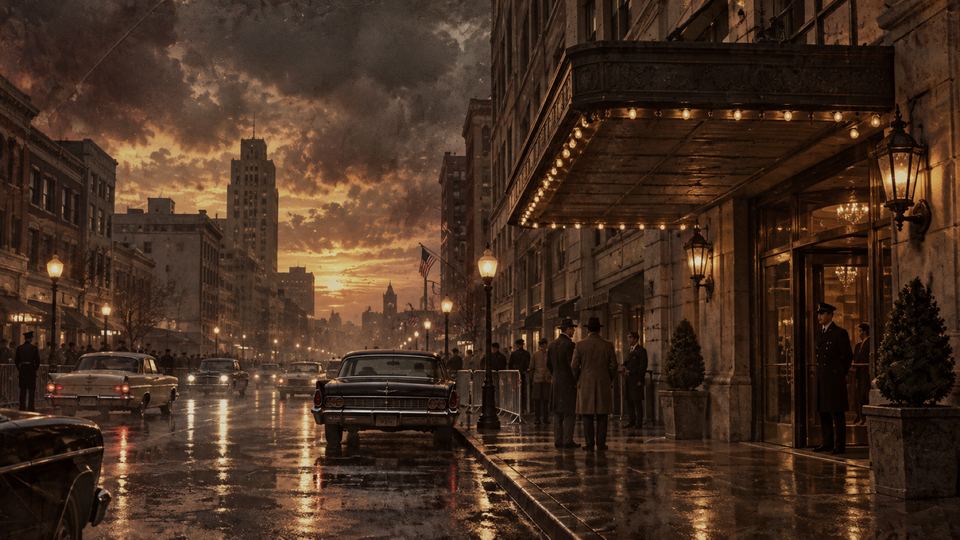
1963
Fort Worth, Texas
The novel opens on the morning President Kennedy arrived in Fort Worth. It is from that morning that Randall Northcutt begins to tell six generations backward.
-
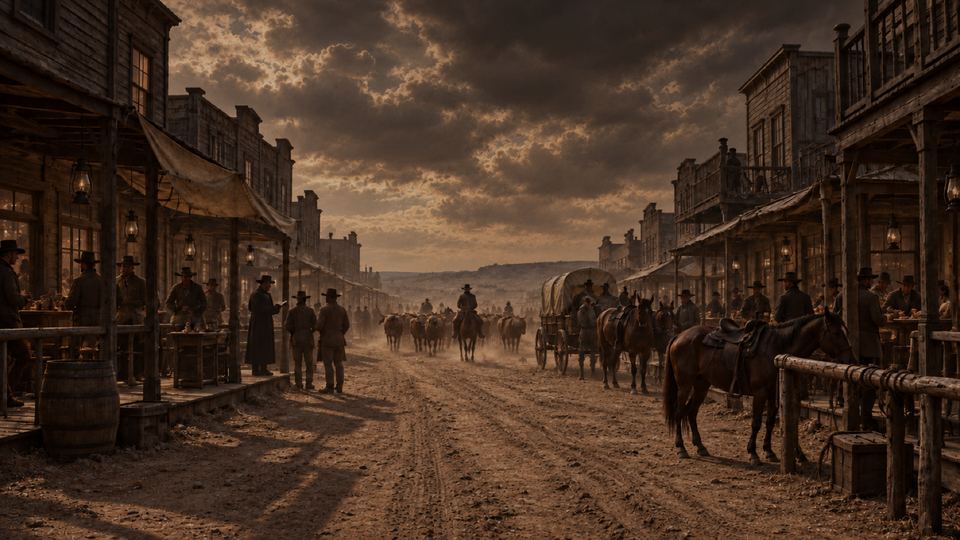
1870s
Hell's Half Acre
Fort Worth's notorious district on the Chisholm Trail: saloons, gambling houses, and the drovers, gunmen, and preachers who passed through it. A real place, and one of the places Randall's memory returns to.
-
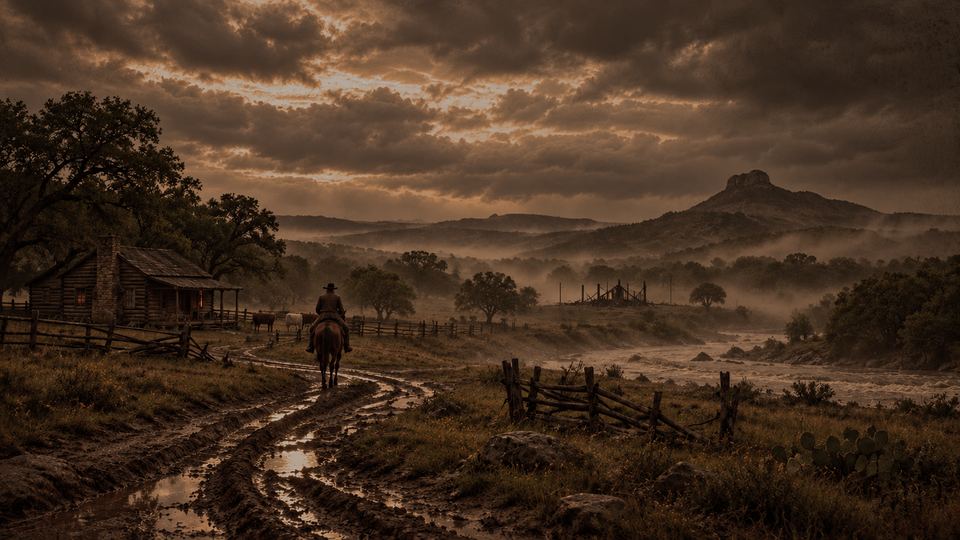
Frontier
The Comanche frontier
Raids, drought, and the hard arithmetic of holding land in a country that demanded a price from everyone who settled it.
-
1836
San Jacinto
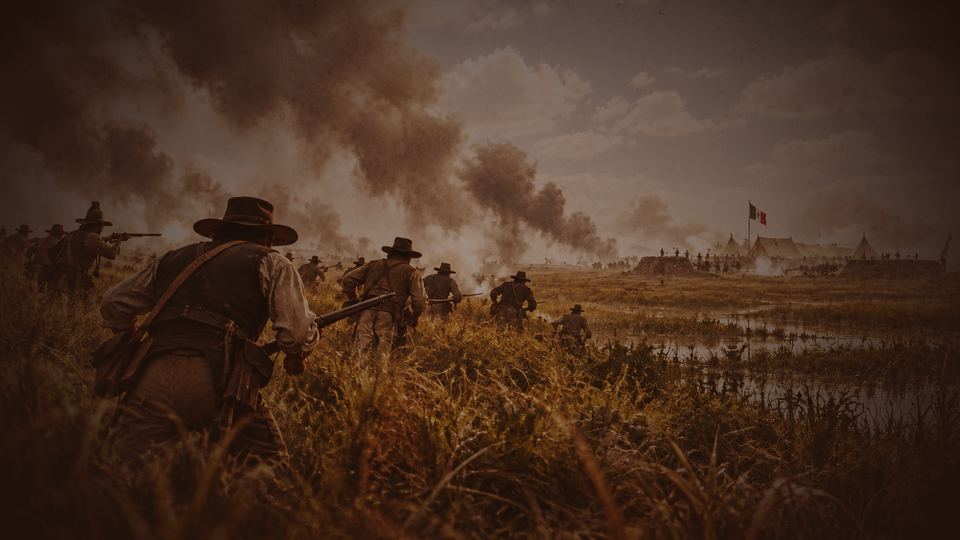
The author's own line reaches back to Henry Mitchell Brewer, who fought at San Jacinto — 180 years of Texas lived by one family before a word of this trilogy was written.
Every story costs someone something.